

🛑 Stop forcing yourself to create content you can't stand and calling it a marketing strategy 🛑
A field guide to marketing in your own nature

Hardly a day goes by that I don’t see a post somewhere from a small-business owner, sole proprietor, or creative saying some version of the same thing: “I cannot stand creating content for social media. I’m exhausted. I’m burned out. I’m putting so much in and getting so little back.”
And yet, not much changes. 😑
I’ve been working for myself for well over a decade now. I’ve worked in and around marketing for most of that time… with brands, with creatives, with solopreneurs, with organizations trying to figure out how to get their gifts and ideas in front of the people they were made for without selling their souls. And the single most baffling thing I witness, consistently, is this: the sheer number of people spending enormous amounts of time, energy, and creative capacity on marketing they cannot stand (and cannot seem to imagine doing differently).
It’s like thinking outside of social media marketing hasn’t fully occurred to them as a possibility.
I don’t say that to be dismissive or judgmental. I say it because I’ve spent a long time trying to understand why this keeps happening… and I think I have a pretty good sense of it now.
Part of it is a seeing problem. When people look for models of how to market a business, they look at what’s most visible. And what’s most visible is the social media presence of large corporations and big brands; ones with dedicated marketing teams, significant budgets, and entire departments whose job is to produce content that the founder probably never personally touches. Those brands aren’t posting because it’s the most effective use of their marketing energy. They’re posting because they can afford to, because it’s expected at their scale, and because it serves an awareness function that large brands with large ad budgets lean into.
We are not those brands. We most likely do not have the same team sizes or the same budgets. And more importantly, we don’t have the same relationship to our work, our clients, and our communities. Comparing ourselves to them and then trying to replicate their approach is a recipe for misalignment from the start.
But the other part (and this is the part I find myself pretty passionate about) is an imagination problem. Or more precisely: a lack of understanding that has closed the imagination down.
Most people I encounter have a very narrow picture of what marketing actually is. It has been so thoroughly collapsed into social media in the public consciousness that the entire rest of the landscape (which is vast and full of approaches that fit radically different kinds of people) has become essentially invisible. So people keep pouring themselves into something that depletes them, not because they’ve tried everything else and this is the best option, but because they genuinely don’t know the other options exist - or how to implement them.
This kind of blows my mind. Marketing that you dread doing is a direct path to burnout, depletion, and misalignment… and misalignment shows up in your results. When you’re forcing yourself into a framework that’s at odds with how you think, how you build trust, and how your energy actually moves, the work shows it. The people you’re trying to reach feel it.
After more than a decade in this world, I’ve gotten pretty clear on what my own marketing style looks and feels like. I’ve also gotten clear that there’s no single right answer… the best marketing any of us can do is the kind that comes from our actual nature, not someone else’s playbook. That’s become one of the things I’m most passionate about helping people find.
This piece is an attempt to give you a framework for doing exactly that.
First up: The actual landscape of Marketing
Before we get into the framework, I want to lay out what marketing can be when you zoom out far enough to see all of it. Notice how many of these you’ve probably never seriously considered for yourself.
Marketing is one of the oldest human activities there is. Before Instagram, before the internet, before printing presses… it was word of mouth, demonstration, reputation, presence, relationship. These are all forms of marketing. What’s happened is that one narrow set of practices has become so dominant in our visual landscape that we’ve stopped seeing everything else.
The many types of marketing:
Content marketing: writing, podcasting, video, newsletters. Creating things people find valuable enough to seek out, return to, and share. The long game. Builds trust and authority over time.
SEO and search discoverability: making sure that when someone is already looking for what you do, they can find you.
Email marketing: the most direct line you have to the people who’ve said they want to hear from you. You own it. No algorithm decides whether or not your message is worthy of showing to others.
Referral and word of mouth: the oldest marketing there is, and still among the most powerful. Underrated in the online business world because it doesn’t come with receiving of dopamine hits we gain via likes, comments, and shares. And yet, this is often the primary source of the most aligned clients.
Community building: creating spaces, gatherings, or conditions where the people who share your values can find each other, and find you.
Collaboration and co-creation: making things with other people, building in public with peers, cross-pollinating through genuine creative exchange rather than forced audience swaps.
Newsletter or Substack publishing: a specific and distinct practice from general email marketing. A place where you build a body of work in public over time, develop a relationship with a recurring readership, and own the list. The long-form, recurring publication as a creative and marketing home.
Speaking, teaching, and embodied presence: being in rooms, physical or virtual, where the people you want to reach already gather. Presence as the message.
IRL and local visibility: showing up in your actual geographic community in ways that are recognizable and relationship-building over time. More powerful than most people realize until they experience it directly.
Curation marketing: gathering, filtering, and pointing toward what matters in your field or ecosystem. A curated newsletter, a roundup, a reading list, a recommendations practice. For some, this is more natural and more sustainable than producing original content.
Social media: yes, this too. One option among many. Useful for discovery and connection. Genuinely unsustainable as the only approach. Not inherently better than anything listed above.
Podcast marketing: audio as a primary channel, whether you’re hosting your own show, guesting on others’, or both. Voice and conversation as the medium of trust-building. Distinct from written content in what it can do - presence, nuance, and real-time thinking come through differently here.
The question is never: which of these is the right one?
The question is: which of these actually fits the way you work, the way your energy moves, the way you build trust, the specific role you play in the ecosystem around you?
That’s where things get interesting.
Discovering your natural approach to marketing
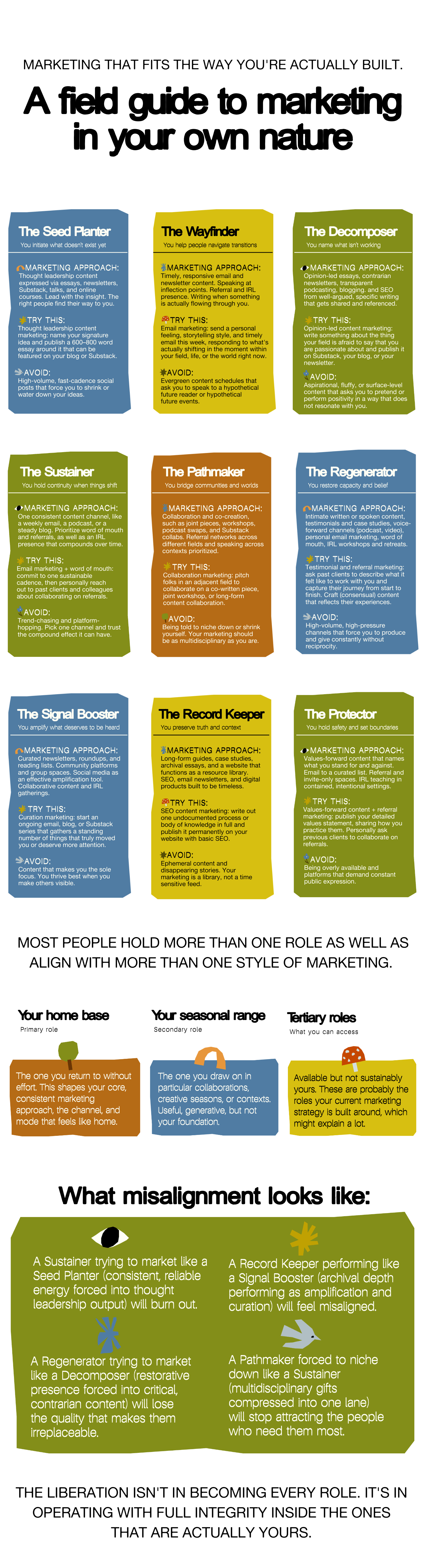
I developed a methodology I call the Ecological Roles of Care: a framework for naming the different essential roles that already exist in living systems, and that already show up in how people move through their communities and their work.
It grew out of something I kept noticing: the people who were most depleted in their businesses weren’t struggling because they lacked skill, vision, or commitment. They were struggling because they were trying to hold roles that didn’t belong to them. Working so hard to show up in ways they’d been told visibility required that they’d completely lost touch with the specific way their own gifts want to move through them and into the world.
This framework I’ve developed names nine distinct roles. And when I started mapping those roles in relation to marketing (asking what each role’s natural way of moving suggests about how a person should be building visibility, reaching people, sustaining a practice), the answers were so specific and so different from each other that it changed how I work with clients.
Read through the descriptions below and notice what lands. What makes you exhale? What makes you think, oh, that’s me, not because it sounds aspirational, but because it sounds familiar.
If you want to go deeper on this
The work of finding your ecological role, your right-fit marketing approach, and the specific verbal and visual expression that makes what you do legible to the people it’s meant for, that’s what I do inside our Messaging Architecture and Thought Leadership Positioning services at DoGoodBiz Studio. It's built entirely around your actual nature rather than a template someone else filled out first. Reach out if you’d like to learn more!
In the meantime, I’d love to know:
What would you stop doing tomorrow if you gave yourself permission to market in your own nature?
Which role made you exhale and feel the most seen?
Drop a comment and let me know 🌈 .
Hi, I’m Natalie Brite, nonbinary creative and founder of DoGoodBiz Studio.
I work at the intersection of creative liberation and social responsibility, partnering with independent businesses, sole proprietors, and values-led creatives on the full range of what it takes to build a meaningful movement: brand ecosystems, web design, content management, marketing strategy, and the harder conversations about ethics that most of the industry is still avoiding.
Most of what you’ve been taught about building a creative life was designed for someone else’s economy… one that runs on urgency, extraction, and the myth of infinite growth. This space runs on something older, and more people + planet focused. Reciprocity. Seasonal rhythm. The wisdom of nature-based systems that have been tending themselves for centuries. You’ll find essays, field guides, and reflections that draw from that different well… on creativity as resistance, ecology as framework, and care as the metric that matters most.
Follow along on Substack for more, or visit our website to learn about working together.
This space functions best when it’s in conversation with what you’re actually navigating. If there’s a question you keep returning to, a tension in your creative work or business you haven’t found the right guidance for, a topic you wish someone would write about honestly, this is where you can bring it!
Your submissions shape the Field Notes, essays, and Creative Camp Radio episodes that come out of the studio.
This work grows through reciprocity. In a forest, nutrients move in circles; nothing is extracted without giving back. A paid subscription is how you return something to the soil. In return: full access to every Field Note, essay, and field guide, plus the occasional members-only dispatch from deep in the studio woods.
I loved this! I was reading through the descriptions, worrying I wouldn't be represented at all and then I read The Signal Booster & immediately knew that was me! Its actually difficult to desire to make "content" but not want to be the center of everything. My secondary is Pathmaker. Thanks so much for this post!
This is such a great read. People are so influenced and fed Social Media is the be all in Marketing yourself, annoys me too.
My photography work comes from word of mouth, talking to people what I’m working. Zine Fairs and niche markets that I know my work speaks to will attend.
I also make physical media people can take for free, postcards etc